
WhatsApp has become the default channel for sales conversations across India and much of the world. It's fast, familiar, and customers actually respond to it. But there's a problem: in most companies, this critical channel runs through the personal phones of individual salespeople — with no visibility, no backup, and no real control for the business.
The numbers explain why sales teams gravitate here in the first place: 72.4% of consumers say they're more likely to buy from a brand that offers messaging as a contact option, and WhatsApp business messages are read within minutes far more often than email (Source: WhatsApp Business, State of Business Messaging Report). Customers already prefer this channel — the question is whether your business actually owns the conversations happening on it.
If your sales team is chatting with leads and customers on their own WhatsApp numbers, you're not really running a sales process. You're trusting your revenue to whichever phone happens to have the conversation on it. Here's why that's a risk worth fixing, and how a WhatsApp CRM solves it.
The Hidden Cost of Personal WhatsApp for Sales
On the surface, using personal WhatsApp seems harmless — even efficient. No new software, no learning curve, everyone already has the app. But as a sales channel, it breaks down in ways that only become obvious once something goes wrong.
1. You lose the conversation when the employee leaves
When a salesperson resigns, their WhatsApp chat history — weeks or months of customer context, pricing discussions, and commitments — leaves with them. The next person starts from zero, and the customer notices immediately.
2. There's no visibility for managers
Sales leaders can't see what's actually being said to customers. Are follow-ups happening on time? Is the messaging consistent? Are reps overpromising? Without access to the conversation, managers are coaching blind and forecasting on guesswork.
3. Leads get lost between chats
A personal WhatsApp inbox mixes customer messages with everything else — friends, family, personal groups. Important leads get buried, follow-ups get forgotten, and there's no system prompting the next action.
4. No integration with your sales data
Conversations on a personal phone never touch your CRM. Deal stages, notes, and customer history stay disconnected from the rest of your sales operation, making reporting and pipeline tracking unreliable.
5. Compliance and data ownership risk
Customer data — phone numbers, preferences, conversation history — sits on a personal device outside company control. That's a real exposure for data privacy compliance and a risk if the device is lost, changed, or the employee is uncooperative on exit.
What Changes With a WhatsApp CRM
A WhatsApp CRM connects your official WhatsApp Business number to your sales system, so every conversation is captured, assigned, and trackable — without asking customers to change how they already communicate.
| Capability | Personal WhatsApp | WhatsApp CRM |
|---|---|---|
| Chat history after a rep leaves | Lost | Retained |
| Manager visibility into conversations | None | Full |
| Syncs with CRM / deal stages | No | Yes |
| Lead auto-assignment | Manual | Automated |
| Data ownership | Employee device | Company infrastructure |
| Multiple reps, one number | Not possible | Supported |
-
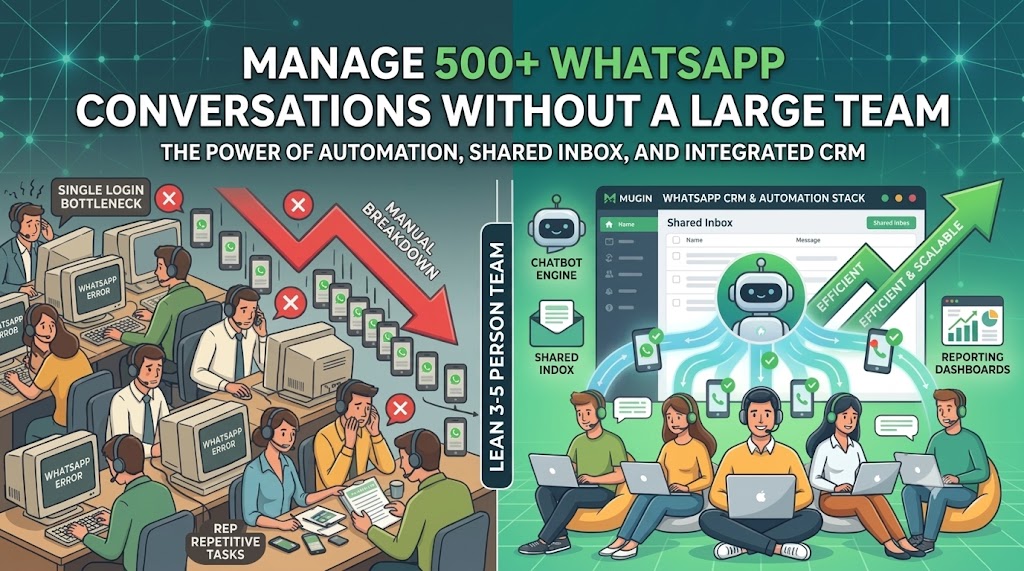
Centralized inbox: every sales conversation lands in one shared, searchable place, visible to the right people — not locked inside a personal device.
-
Continuity across the team: when a rep is on leave or leaves the company, chat history and context stay with the business, so nothing is lost.
-
Automated lead capture and routing: new WhatsApp enquiries can be auto-assigned to the right rep based on rules you define, cutting response time.
-
CRM-native context: conversations sync with deal stages, contact records, and notes, so every message is backed by full customer history.
-
Manager visibility and reporting: track response times, follow-up rates, and conversation quality — and coach with real data instead of guesswork.
-
Data stays with the company: customer information and chat history are stored on company infrastructure, not a personal SIM card.
The Bottom Line
Personal WhatsApp got sales teams moving fast when there was no better option. But as a business scales, it turns a competitive advantage into a liability — one dependent on individual phones instead of a repeatable process.
A WhatsApp CRM keeps the speed and familiarity your customers already like, while giving your business what personal WhatsApp never could: ownership, visibility, and continuity.
If your sales conversations are still happening on personal phones, the question isn't whether to make the switch — it's how much longer you can afford not to.
Frequently Asked Questions
What is a WhatsApp CRM?
A WhatsApp CRM is software that connects a business's official WhatsApp Business number to its sales or customer system, so conversations are centralized, assigned to team members, logged against customer records, and visible to managers — instead of living on individual employees' personal phones.
Is it legal or compliant to use WhatsApp for sales conversations?
Yes, when done through the official WhatsApp Business Platform (API) with proper opt-ins. What creates risk is routing customer data through personal, unmanaged WhatsApp accounts, which falls outside company data-protection controls and most internal compliance policies.
Can our team keep the same WhatsApp number when switching to a WhatsApp CRM?
In most cases, yes — an existing number can be migrated to WhatsApp Business, or a new dedicated business number can be used. Either way, the number becomes company-owned rather than tied to one employee's device.
How is a WhatsApp CRM different from the free WhatsApp Business app?
The WhatsApp Business app is still a single-device, single-login tool much like personal WhatsApp. A WhatsApp CRM adds shared team inboxes, automated lead routing, CRM/deal-stage sync, manager reporting, and centralized data ownership — the pieces a growing sales team actually needs.
Will switching to a WhatsApp CRM disrupt customers?
No. Customers keep messaging the same way they already do on WhatsApp. The change happens entirely on the business side — in who can see, manage, and respond to the conversation.