
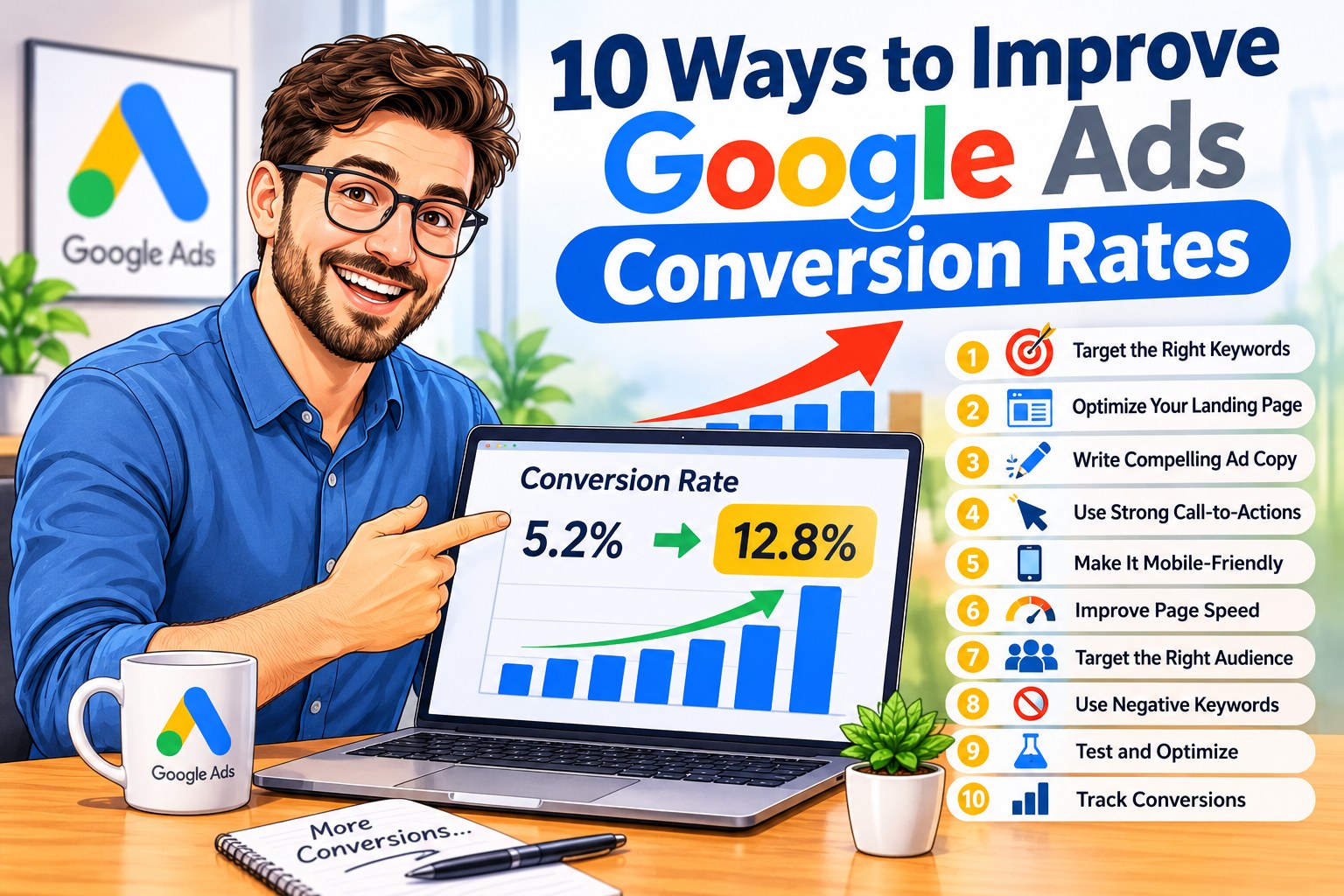
Many businesses judge their Google Ads by clicks and impressions. But clicks do not pay the bills; conversions do. A conversion is the action you want a visitor to take: a phone call, a form submission, a purchase, or a booking. Your conversion rate is the percentage of clicks that turn into one of these actions.
A higher conversion rate means you get more customers from the same budget. Here are 10 proven ways to improve it.
1. Set Up Conversion Tracking First
You cannot improve what you do not measure. Before changing anything, make sure Google Ads is tracking the actions that matter: form submissions, calls, WhatsApp clicks, purchases, or bookings. With accurate data you can see which keywords, ads, and devices actually produce customers, and stop guessing.
2. Target High-Intent Keywords
Not all searches are equal. Someone searching "buy running shoes online" is closer to purchasing than someone searching "history of running shoes." Focus on keywords that show buying intent, such as "near me," "price," "buy," "book," "hire," or your specific service name. Use exact and phrase match types to keep traffic relevant.
3. Add Negative Keywords
Irrelevant clicks lower your conversion rate and waste money. Add negative keywords to block searches like "free," "jobs," "DIY," or "course" if they do not fit your business. Review your search terms report every week and add new negatives as you find them.
4. Write Ads That Match the Searcher's Intent
Your ad should clearly say what you offer and who it is for. Include the main keyword in the headline, highlight a real benefit, and finish with a clear call to action such as "Get a Free Quote" or "Book Today." Honest, specific ads attract the right clicks and discourage the wrong ones.
5. Send Traffic to a Dedicated Landing Page
Sending clicks to a general homepage is one of the biggest conversion killers. A dedicated landing page that matches your ad's message, offers one clear action, and removes distractions will almost always convert better. Keep the headline consistent with the ad so visitors know they are in the right place.
6. Make Your Landing Page Fast and Mobile-Friendly
Most searches happen on phones, and many visitors leave if a page takes more than a few seconds to load. Compress images, keep the design simple, and make sure buttons are easy to tap. Test your page on a real phone, not just a desktop screen.
7. Simplify Your Forms and Calls to Action
Every extra form field reduces submissions. Ask only for what you truly need, usually a name, phone number, and one detail about the request. Use one strong, visible call to action, and add a click-to-call button for service and local businesses.
8. Build Trust with Social Proof
Visitors are more likely to convert when they trust you. Add customer reviews, testimonials, ratings, before-and-after photos, certifications, and the number of customers you have served. For local businesses, a visible address and real photos of your team or shop make a big difference.
9. Use Ad Extensions and Location Targeting
Ad extensions give people more reasons to choose you. Add call extensions, location extensions, sitelinks, and callouts like "Free Delivery" or "Same-Day Service." Combine these with tight location targeting and ad schedules so your ads appear to nearby people during the hours you can actually answer calls.
10. Test, Review, and Optimize Regularly
Conversion rate improvement is an ongoing process. Test different headlines, offers, images, and button text, changing one thing at a time. Check performance by device, location, and time of day, then adjust bids and budgets toward what works. Review your campaigns weekly and pause keywords that spend money without converting