
A website is one of the most important digital assets for a modern business. It helps customers discover your company, understand your services, submit enquiries, and interact with your brand.
However, launching a website is not the end of the process. Like any business system, a website needs regular updates, security checks, backups, performance monitoring, and content management.
When website maintenance is ignored for a long time, small technical issues can gradually become serious problems. From security risks and slow loading speeds to broken features and lost customers, an unmaintained website can negatively affect your business.
What Is Website Maintenance?
Website maintenance is the ongoing process of keeping a website secure, functional, updated, and performing properly.
Regular maintenance can include:
· Software and plugin updates
· Security monitoring
· Website backups
· Malware checks
· Performance optimization
· Broken-link checking
· Content updates
· SSL/HTTPS checks
· Database maintenance
· Mobile responsiveness testing
· Technical troubleshooting
Ignoring these activities can create problems that become increasingly difficult and expensive to resolve.
1. Your Website Becomes More Vulnerable to Security Problems
One of the biggest risks of ignoring website maintenance is increased exposure to security vulnerabilities.
Websites often rely on software, plugins, themes, libraries, and third-party integrations. When these components are outdated, known vulnerabilities may remain unresolved.
Security problems can potentially result in:
· Unauthorized access
· Malware infections
· Suspicious redirects
· Unwanted website content
· Data exposure
· Website downtime
Regular maintenance helps businesses identify and address security issues proactively.
2. Your Website May Become Slow
Website performance can decline over time.
Large images, outdated plugins, unnecessary files, database issues, and inefficient scripts can contribute to slower page loading.
A slow website can lead to:
· Poor user experience
· Higher visitor drop-off
· Lower engagement
· Fewer enquiries
· Reduced customer satisfaction
Regular performance monitoring helps identify areas that need optimization.
3. Website Features Can Stop Working
Websites often depend on multiple components working together.
For example, your website may have:
· Contact forms
· WhatsApp integration
· Payment gateways
· CRM integrations
· Email notifications
· Booking systems
· Product search
· Customer login systems
If software or integrations become outdated, some features may stop working correctly.
Regular maintenance helps businesses identify these problems before they affect a large number of visitors.
4. You Could Lose Important Business Data
Without regular backups, recovering your website after a serious technical problem can become difficult.
Data could potentially be affected by:
· Failed updates
· Server problems
· Accidental deletion
· Malware
· Security incidents
· Technical errors
A proper backup strategy provides an additional layer of protection and can make recovery much easier.
5. Your Website Content Becomes Outdated
An unmaintained website may continue displaying information that is no longer accurate.
Examples include:
· Old phone numbers
· Outdated addresses
· Discontinued services
· Old pricing
· Previous offers
· Outdated team information
· Old company details
Incorrect information can create confusion and reduce customer trust.
Regular content reviews ensure that your website continues to represent your business accurately.
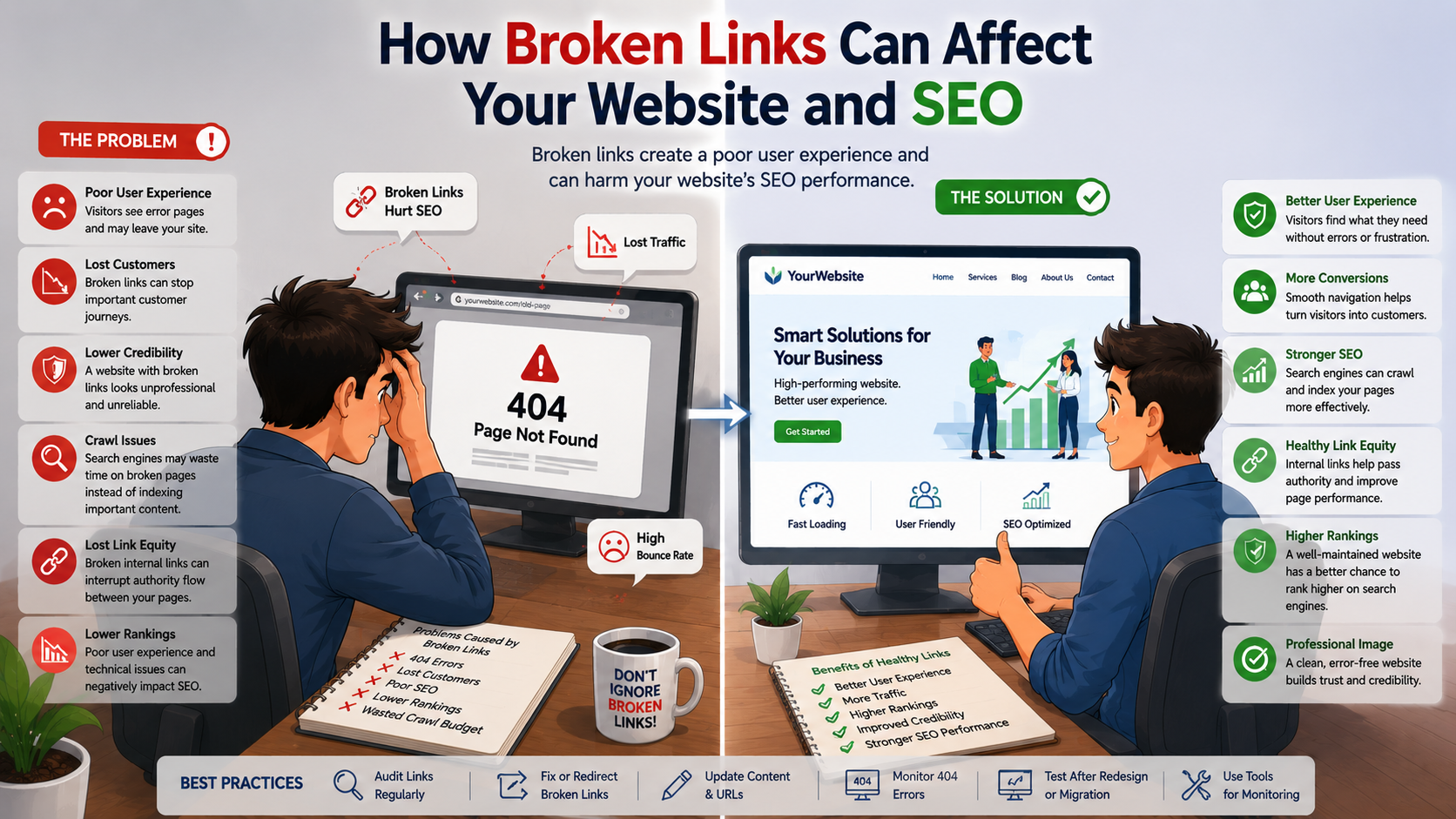
6. Broken Links Can Accumulate
Websites change over time. Pages may be removed, URLs may change, and external websites may become unavailable.
Without regular checking, your website may gradually develop broken links.
Broken links can:
· Frustrate visitors
· Interrupt navigation
· Create a poor user experience
· Make important information difficult to access
· Affect website quality
Regular maintenance can help identify and fix broken links.
7. Your SEO Performance Can Be Affected
Website maintenance is also important for maintaining a healthy SEO foundation.
Problems such as:
· Broken links
· Slow loading pages
· Poor mobile experience
· Technical errors
· Outdated content
· Incorrect redirects
can negatively affect the overall quality of your website.
Regular maintenance allows businesses to identify technical and content-related issues that could affect search visibility.
8. Your Website May Stop Working Properly on Mobile Devices
Technology and browsers continue to change. A website that worked well several years ago may not provide the same experience today.
Without regular testing, you may discover issues with:
· Mobile navigation
· Buttons
· Forms
· Images
· Page layouts
· Menus
Regular mobile testing helps ensure that customers can access your website comfortably across different devices.
9. Your Brand Can Look Unprofessional
Your website is often one of the first places potential customers interact with your business.
Imagine a visitor finding:
· Broken images
· Missing pages
· Outdated information
· Slow-loading screens
· Security warnings
· Non-working forms
These problems can affect how customers perceive your business.
A well-maintained website communicates professionalism, reliability, and attention to detail.
10. You Can Lose Potential Customers
All of the problems above can eventually affect your business results.
For example:
Slow website → Visitor leaves → No enquiry
Broken contact form → Customer cannot contact you → Lost opportunity
Outdated information → Customer loses trust → Lost business
Security problem → Website becomes unavailable → Business disruption
Regular maintenance helps reduce these avoidable risks.
11. Emergency Repairs Can Cost More
Ignoring small website problems does not necessarily make them disappear.
A minor issue that could have been fixed during regular maintenance may become a larger technical problem later.
For example:
Regular maintenance:
Identify → Fix → Monitor
No maintenance:
Ignore → Problem grows → Website disruption → Emergency repair
Proactive maintenance can therefore help businesses avoid unnecessary emergency work and downtime.
12. Third-Party Integrations May Become Unreliable
Modern websites often depend on external services and APIs.
These may include:
· Payment gateways
· CRM systems
· ERP systems
· Email services
· Analytics platforms
· Marketing tools
Third-party services can change their APIs, authentication requirements, or technical specifications.
Regular maintenance allows these integrations to be checked and updated when required.
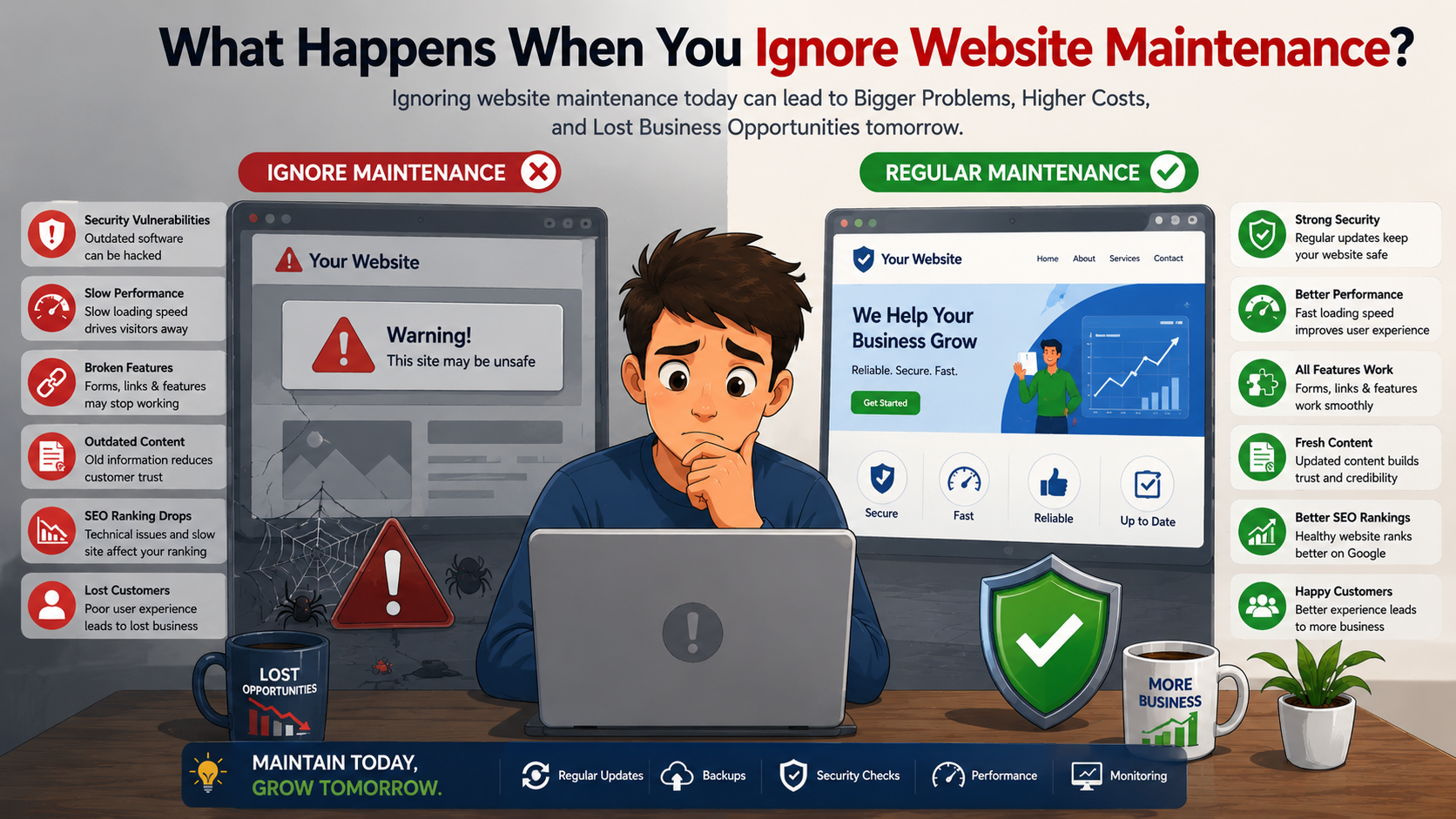
What Happens When Website Maintenance Is Ignored?
The impact can be summarized as:
| Without Maintenance | Possible Result |
| Outdated software | Security vulnerabilities |
| Large and unoptimized files | Slow website |
| No backups | Difficult recovery |
| Broken links | Poor user experience |
| Outdated content | Reduced customer trust |
| Unchecked forms | Lost enquiries |
| Old integrations | Features may stop working |
| No mobile testing | Poor mobile experience |
| Technical SEO issues | Reduced search visibility |
| No monitoring | Problems discovered too late |
Website Maintenance Checklist
A professional website maintenance routine should include:
· ✅ Security monitoring
· ✅ Software updates
· ✅ Plugin and theme updates
· ✅ Regular backups
· ✅ Malware checks
· ✅ SSL/HTTPS checks
· ✅ Performance monitoring
· ✅ Broken-link checks
· ✅ Content updates
· ✅ Mobile testing
· ✅ Contact-form testing
· ✅ Database maintenance
· ✅ Integration testing
· ✅ SEO checks
Website Maintenance vs. Website Redesign
Maintenance and redesign serve different purposes.
Website maintenance focuses on keeping your existing website secure, updated, functional, and reliable.
Website redesign involves larger changes to the website's design, structure, content, user experience, and functionality.
If your website only has occasional technical or content issues, regular maintenance may be sufficient.
However, if your website has an outdated design, poor mobile experience, major performance problems, or an ineffective structure, a website redesign may be worth considering.
Why Choose Mugin Technologies for Website Maintenance?
At Mugin Technologies, we help businesses maintain their websites and keep them secure, updated, and performing reliably.
Our website maintenance services include:
· Website security monitoring
· Software and plugin updates
· Website backups
· Malware monitoring
· SSL/HTTPS checks
· Performance optimization
· Content updates
· Broken-link fixing
· Technical troubleshooting
· SEO maintenance
· Ongoing website support
We help businesses maintain a reliable online presence while allowing them to focus on their core business activities.
Conclusion
Ignoring website maintenance can create problems that affect your security, performance, SEO, customer experience, and business opportunities.
A website may continue to work for months or even years without regular maintenance, but that does not mean it is operating at its best or remaining secure.
Regular updates, backups, security checks, performance monitoring, content reviews, and technical testing can help prevent small problems from becoming major disruptions.
Your website is an ongoing business investment. Maintaining it regularly helps protect that investment and keeps your digital presence ready for your customers.