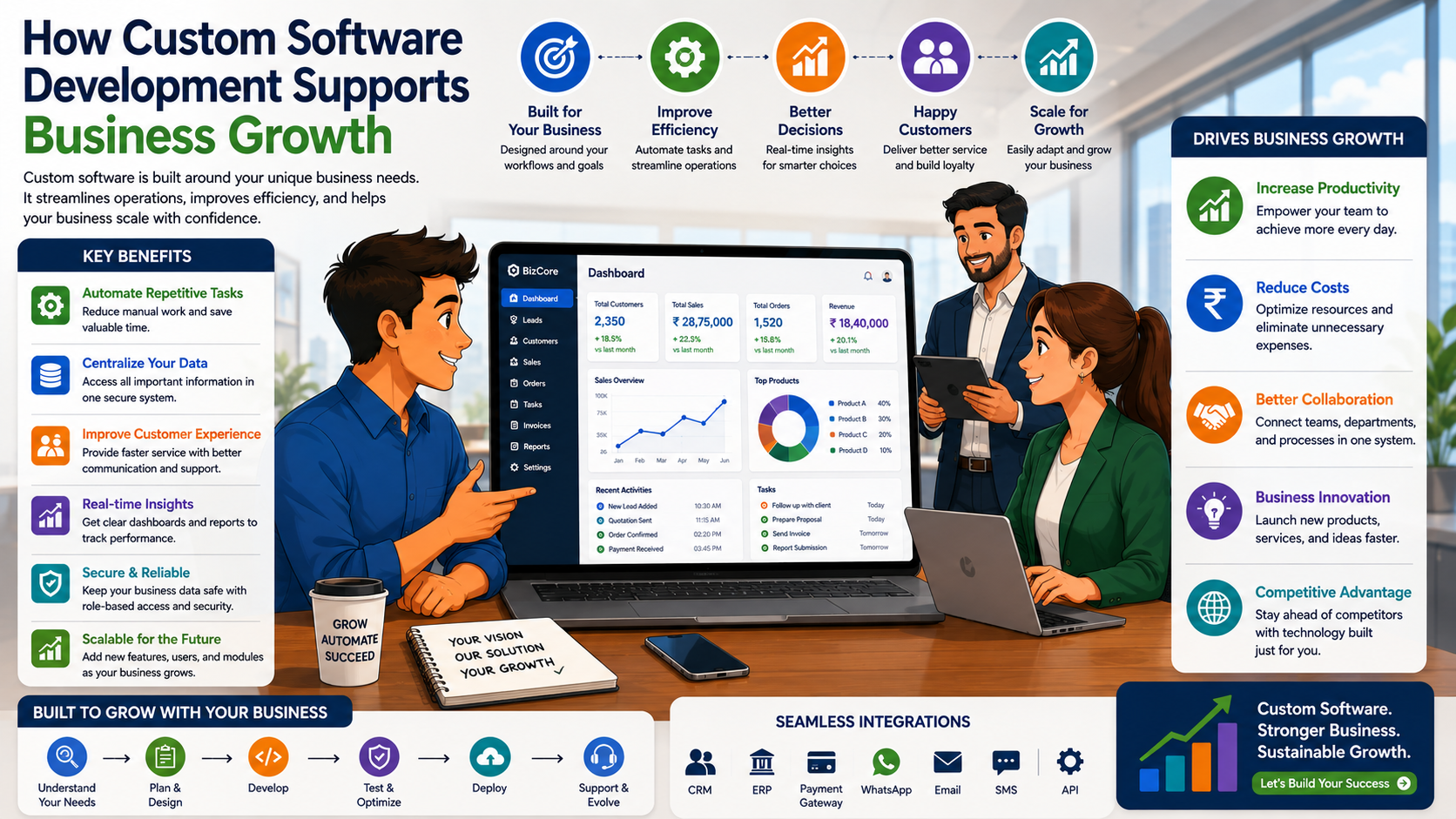
As businesses grow, their operations become more complex. Managing customers, sales, employees, inventory, reporting, and daily workflows through spreadsheets and disconnected applications can make it difficult to maintain efficiency.
Custom software development provides businesses with technology designed around their specific requirements. Instead of adapting business processes to fit generic software, organizations can build solutions that support their workflows, improve productivity, and scale with their growth.
At Mugin Technologies, we develop secure, scalable, and user-friendly custom software solutions that help businesses streamline operations and build a stronger foundation for long-term growth.
What Is Custom Software Development?
Custom software development is the process of designing and developing software specifically for the requirements of a business.
A custom solution can be developed around:
· Business workflows
· Operational requirements
· Customer needs
· Employee processes
· Reporting requirements
· Automation needs
· Third-party integrations
· Future growth plans
Depending on the business requirement, custom software can be developed as a web application, mobile application, cloud-based platform, or other business software solution.
Why Is Custom Software Important for Growing Businesses?
Ready-made software can be useful for standard business requirements. However, growing businesses often develop unique workflows that existing software may not fully support.
Common challenges include:
· Repetitive manual tasks
· Multiple disconnected systems
· Duplicate data entry
· Difficult reporting
· Limited automation
· Communication gaps
· Inability to customize workflows
· Difficulty managing increasing business volume
Custom software can address these challenges by creating a centralized and flexible technology solution.
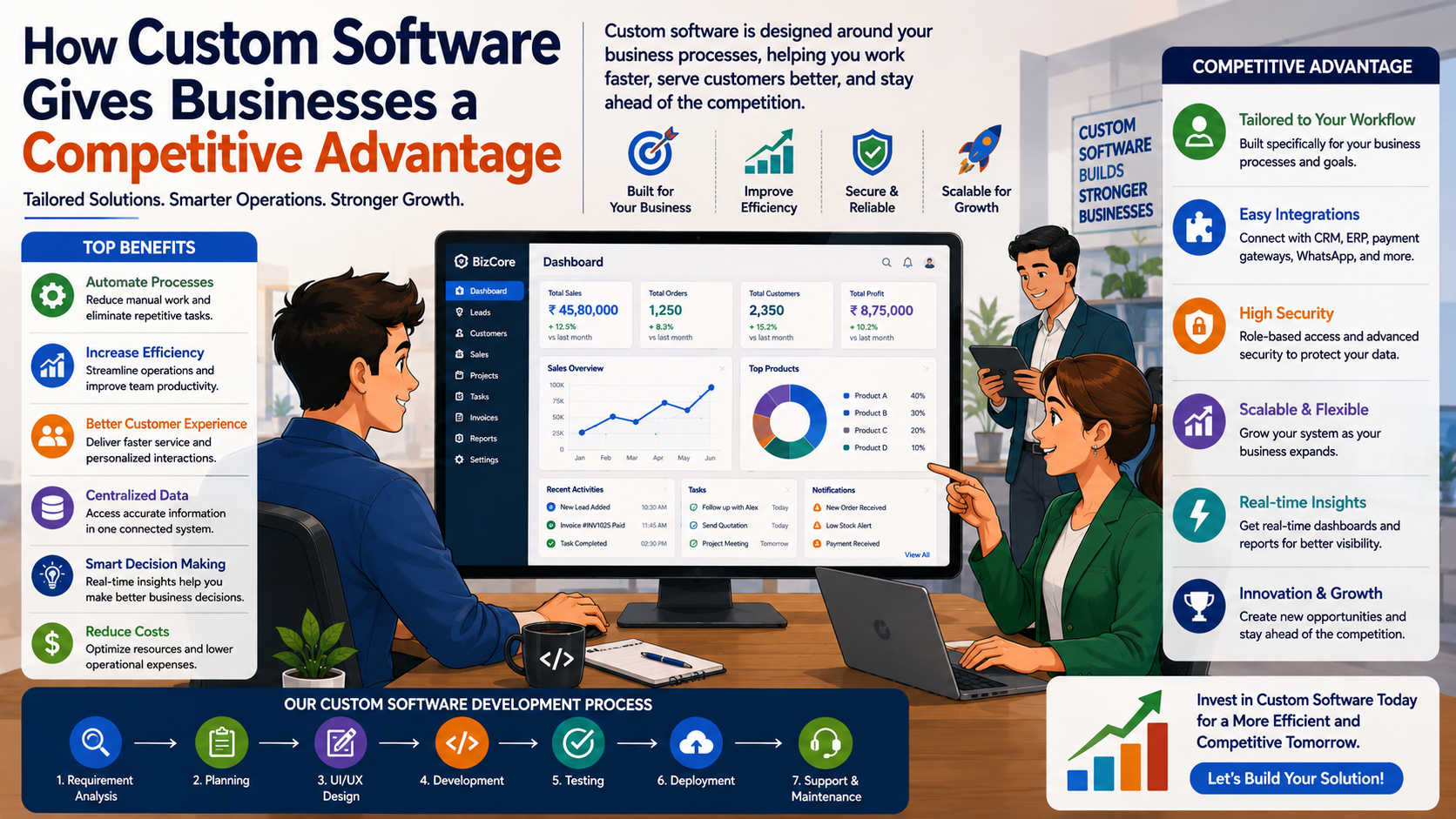
How Custom Software Supports Business Growth
1. Built Around Your Business
One of the biggest advantages of custom software is that it can be designed around your business processes.
For example, a company may follow a workflow such as:
Lead → Follow-up → Quotation → Approval → Order → Payment
Instead of changing this workflow to match generic software, a custom application can be developed to support the process directly.
This makes the software more relevant to the way your business operates.
2. Improves Operational Efficiency
As a business grows, inefficient processes can consume more employee time.
Custom software can streamline different activities and reduce unnecessary manual steps.
It can help automate:
· Data entry
· Lead assignments
· Notifications
· Approvals
· Follow-up reminders
· Invoice generation
· Report generation
· Order processing
Improved efficiency allows employees to spend more time on important business activities.
3. Automates Repetitive Work
Repetitive tasks can slow down business operations and increase the possibility of human errors.
Custom software can automate routine workflows based on predefined business rules.
For example:
New Lead → Automatic Assignment → Follow-up Reminder → Notification → Sales Update
Automation can help teams process tasks faster and maintain consistency.
4. Centralizes Business Data
Growing companies often use different systems to manage different departments.
Sales may use one system, finance another, while customer information may be stored in spreadsheets or emails.
Custom software can bring important information into a centralized platform.
For example:
Customers + Sales + Orders + Payments + Reports
can be connected within one system.
Centralized data provides better visibility and reduces the need to manage information across multiple disconnected platforms.
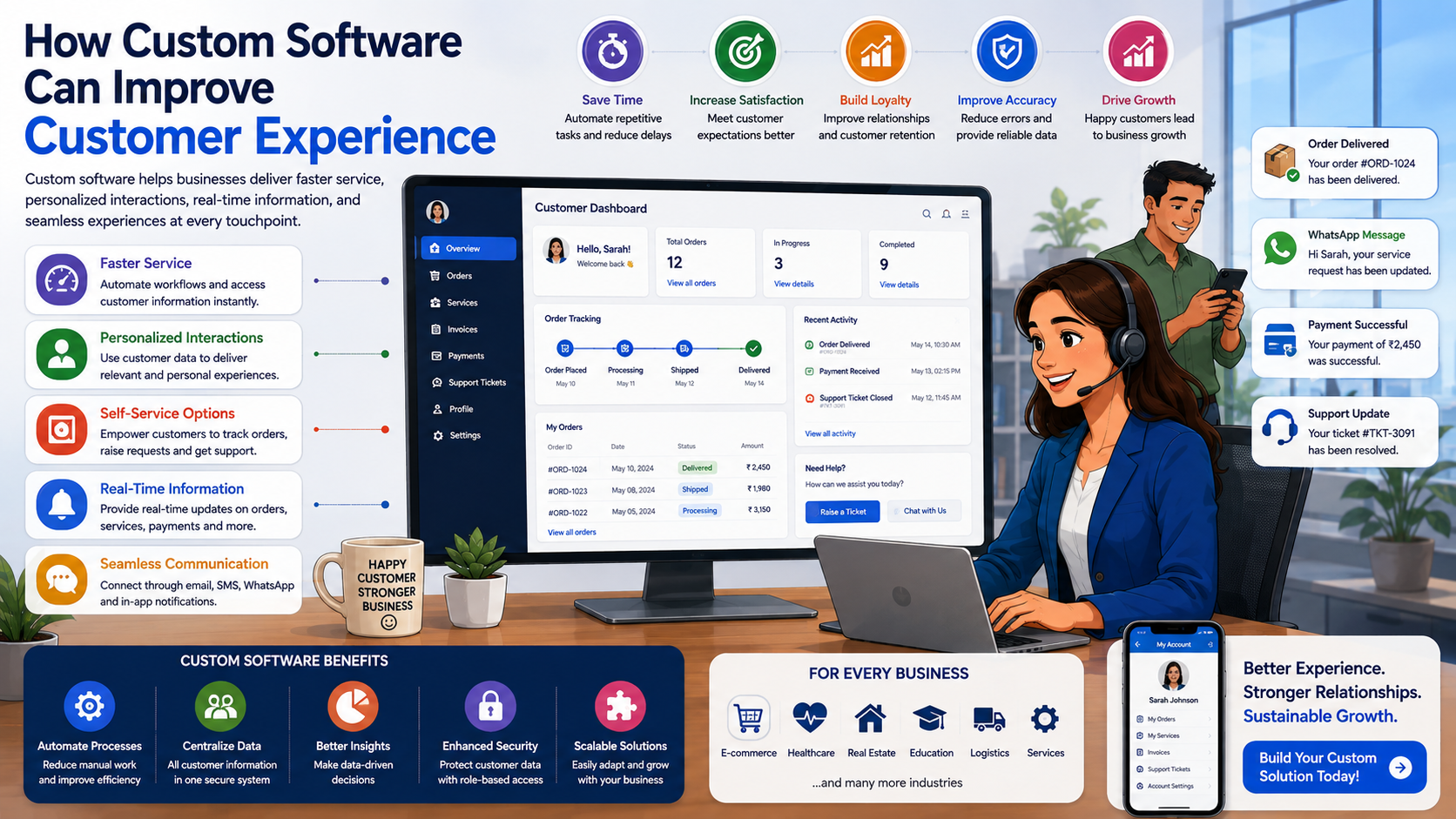
5. Improves Customer Experience
Business growth depends not only on acquiring customers but also on providing a good customer experience.
Custom software can provide features such as:
· Customer portals
· Online booking
· Order tracking
· Automated notifications
· Customer support
· Personalized dashboards
· Online payment options
These features can make interactions more convenient and help businesses build stronger customer relationships.
6. Provides Better Business Insights
Business growth requires informed decision-making.
Custom software can provide dashboards and reports that help management monitor important business information.
Reports can include:
· Sales performance
· Revenue
· Customer activity
· Order volume
· Inventory
· Expenses
· Employee performance
· Operational metrics
Having relevant information in one place can help businesses understand performance and identify areas for improvement.
7. Connects Different Business Systems
Businesses often depend on several digital platforms.
Custom software can integrate with:
· CRM systems
· ERP platforms
· Payment gateways
· Email systems
· SMS services
· E-commerce platforms
· Accounting software
· Third-party APIs
Integrations can reduce duplicate data entry and allow different systems to work together more efficiently.
8. Supports Business Scalability
A growing business may need to handle more customers, employees, transactions, and locations.
Custom software can be designed with scalability in mind.
As the business expands, the system can be extended with:
· New users
· New departments
· New modules
· New locations
· Additional integrations
· New reports
· Additional workflows
This allows the software to evolve alongside the organization.
9. Helps Reduce Operational Costs
Custom software can help businesses reduce unnecessary operational work through automation and process optimization.
Potential areas of improvement include:
· Manual administration
· Repetitive data entry
· Duplicate processes
· Manual reporting
· Data errors
· Multiple disconnected tools
While custom software requires an initial development investment, the long-term value depends on how effectively it improves the business processes it is designed to support.
10. Gives Businesses Greater Flexibility
Business requirements can change as the organization grows.
A company may introduce a new product, expand into another market, add a new department, or change its customer management process.
Custom software provides the flexibility to introduce new functionality based on these changing requirements.
This can help businesses adapt their technology without completely replacing their existing system.
11. Strengthens Business Security
Custom applications can be designed with security requirements appropriate to the business.
Depending on the system, security features can include:
· User authentication
· Role-based access
· Permission management
· Secure data handling
· Activity tracking
· Backup systems
· Secure integrations
Controlling access to business information can help organizations manage sensitive data more effectively.
12. Creates Opportunities for Innovation
Custom software can help businesses develop new ways of serving customers and managing operations.
Organizations can create:
· Customer portals
· Mobile applications
· SaaS platforms
· Online marketplaces
· Automated service systems
· Industry-specific applications
· Self-service platforms
Technology can therefore become an important part of a company's growth and innovation strategy.
Custom Software vs. Off-the-Shelf Software
| Custom Software | Off-the-Shelf Software |
| Built around specific business requirements | Designed for general requirements |
| Flexible workflows | Predefined workflows |
| Custom features | Standard features |
| Can support specialized processes | Customization varies |
| Can integrate with required systems | Integration options vary |
| Can evolve with business needs | Depends on vendor capabilities |
| Higher initial development investment | Often quicker to implement |
Off-the-shelf software can be suitable when its existing features match your requirements. Custom software becomes more valuable when your business has specialized processes or needs greater flexibility.
Signs Your Business May Need Custom Software
Your business may benefit from custom software if:
· Your team relies heavily on spreadsheets
· Employees perform repetitive manual tasks
· You use several disconnected applications
· Existing software does not match your workflow
· You need specialized functionality
· Your reporting process is time-consuming
· Your business is expanding rapidly
· You need multiple systems to communicate
· Manual processes are creating errors
· Your current software limits future growth
Custom Software Development Process
A successful software project begins with a clear understanding of the business.
1. Requirement Analysis
Understand the business objectives, challenges, users, workflows, and required features.
2. Planning
Define the modules, technology, integrations, development approach, and project roadmap.
3. UI/UX Design
Create interfaces that are simple, intuitive, and suitable for the intended users.
4. Development
Build the required modules and functionality based on the approved requirements.
5. Integration
Connect the application with required APIs, payment systems, CRM, ERP, communication platforms, or other tools.
6. Testing
Test functionality, security, performance, integrations, and user workflows.
7. Deployment
Deploy the completed application to the appropriate production environment.
8. Support and Maintenance
Monitor the software after launch and provide updates, improvements, and technical support as required.
Industries That Can Benefit From Custom Software
Custom software can support businesses across many industries.
Manufacturing
Manage production, inventory, procurement, and operational workflows.
Construction
Manage projects, quotations, materials, expenses, and workforce information.
Real Estate
Manage leads, property information, site visits, follow-ups, and sales.
Healthcare
Manage appointments, records, billing, and communication workflows.
Education
Manage admissions, students, fees, staff, and communication.
Retail and E-Commerce
Manage customers, products, inventory, orders, payments, and sales.
Logistics
Manage deliveries, vehicles, warehouses, routes, and tracking.
At Mugin Technologies, we develop custom software solutions based on the unique requirements of each business.
Our services include:
· Custom Software Development
· Custom Web Application Development
· Business Automation Solutions
· CRM Development
· ERP Development
· SaaS Application Development
· API Integration
· Dashboard and Reporting Solutions
· Cloud-Based Software Development
· Software Maintenance and Support
Our focus is on creating secure, scalable, user-friendly, and business-focused software solutions that can adapt as your organization grows.
Custom software development can provide businesses with the flexibility and technology they need to improve efficiency and support long-term growth.
By automating repetitive tasks, centralizing information, connecting business systems, improving customer experiences, and providing better insights, custom software can help organizations operate more effectively.
For growing businesses with specialized requirements, custom software is not simply a technology investment. It can become a strategic tool for improving operations, supporting innovation, and creating a scalable foundation for future growth.
If your existing software is limiting your operations or your team is spending too much time on manual processes, a custom software solution may help your business move toward a more efficient and scalable future.