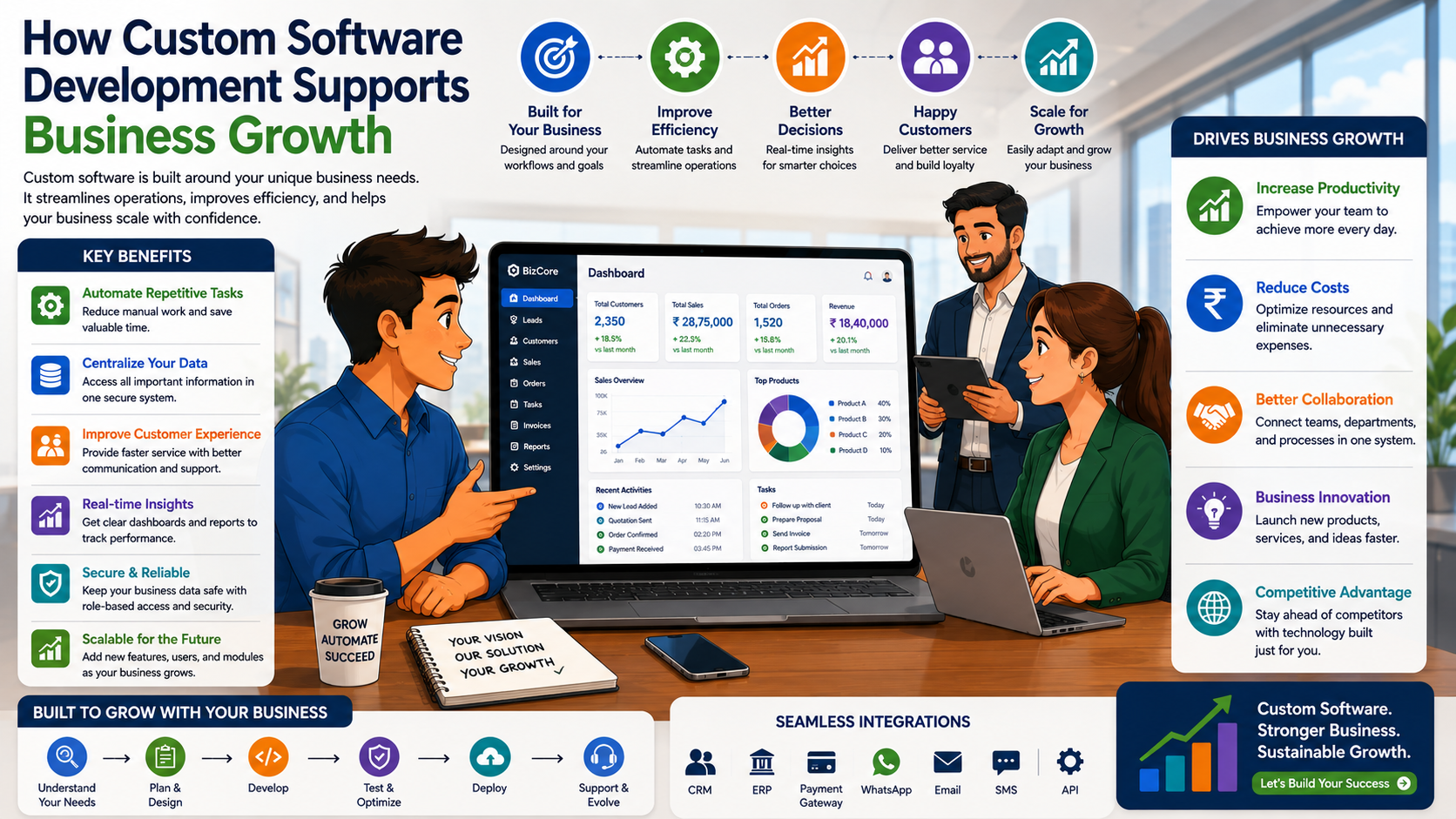
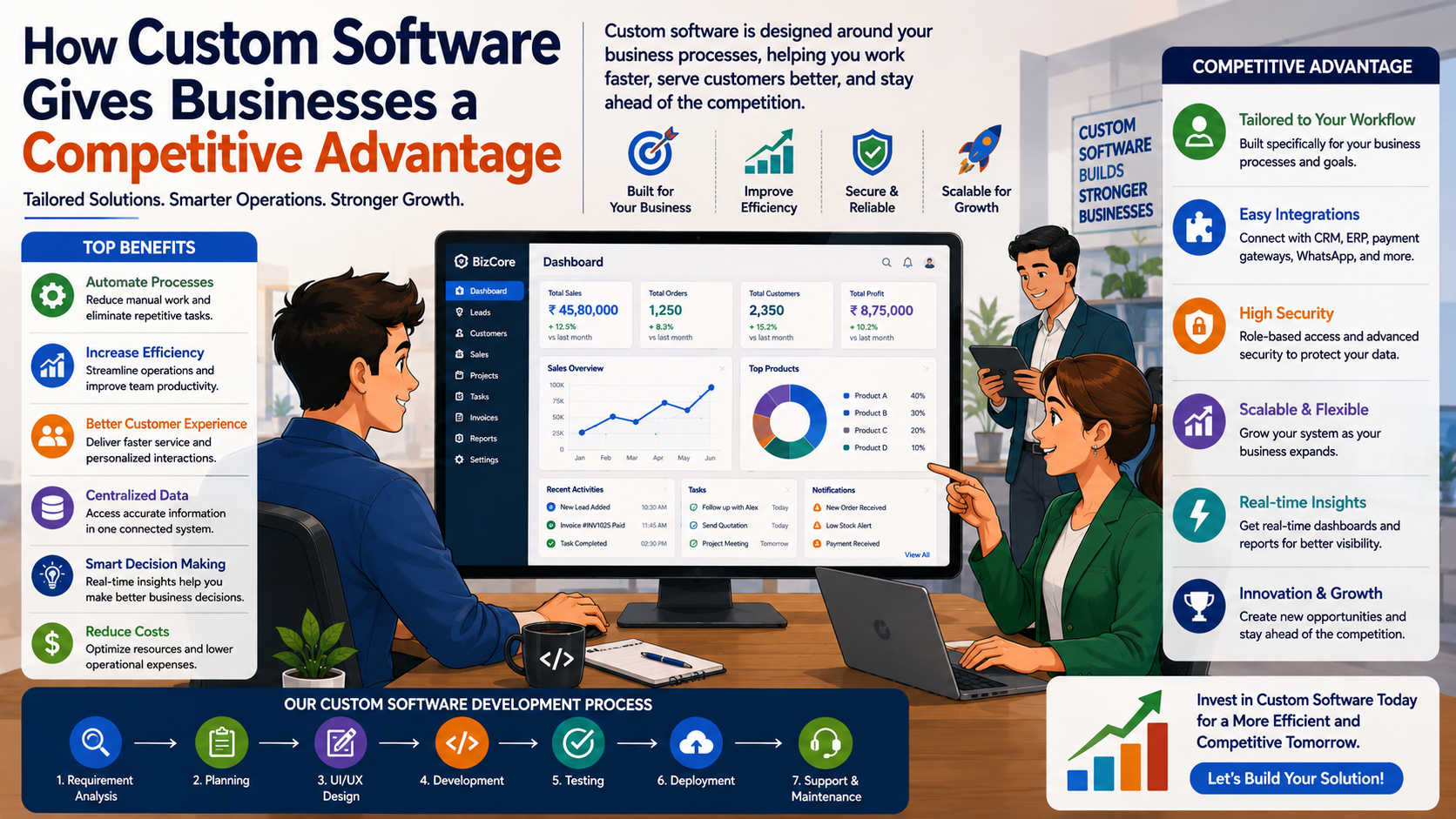
In a competitive business environment, technology can play an important role in helping companies work faster, serve customers better, and respond to changing market demands. While ready-made software can provide useful standard features, it may not always match the unique processes and requirements of a growing business.
Custom software development allows businesses to build solutions around their specific workflows, customers, and operational needs. By combining automation, integration, real-time information, and scalable functionality, custom software can help businesses create a stronger competitive position.
At Mugin Technologies, we develop secure, scalable, and user-friendly custom software solutions designed around the unique requirements of businesses.
What Is Custom Software?
Custom software is an application developed specifically for the requirements of a particular business or organization.
Instead of changing your business processes to fit existing software, custom software can be designed around your existing workflows.
It can help businesses manage:
· Customers and leads
· Sales and orders
· Inventory
· Finance and billing
· Employee operations
· Reports and analytics
· Customer support
· Business workflows
· Third-party integrations
This flexibility can help organizations operate more efficiently and respond to customer needs more effectively.
How Custom Software Creates a Competitive Advantage
1. Tailors Technology to Your Business
Every business operates differently. A generic application may include features you never use while missing functionality that is important to your business.
Custom software can be developed around your specific requirements.
For example, a business may need a workflow such as:
Lead → Follow-up → Quotation → Approval → Order → Payment
A custom application can be designed to support this process without unnecessary steps.
This allows technology to work as a natural part of the business rather than becoming an obstacle.
2. Automates Repetitive Tasks
Manual processes can consume employee time and increase the possibility of errors.
Custom software can automate repetitive activities such as:
· Data entry
· Lead assignment
· Follow-up reminders
· Notifications
· Approvals
· Invoice generation
· Report generation
· Order processing
Automation allows employees to spend more time on activities that require decision-making, customer interaction, and business development.
3. Helps Employees Work More Efficiently
When employees have to switch between multiple applications and spreadsheets, managing information can become time-consuming.
Custom software can bring important processes into a centralized system.
For example:
Customer Information + Sales + Orders + Payments + Reports
can be managed through a connected platform.
This can reduce duplicate data entry and make everyday operations more efficient.
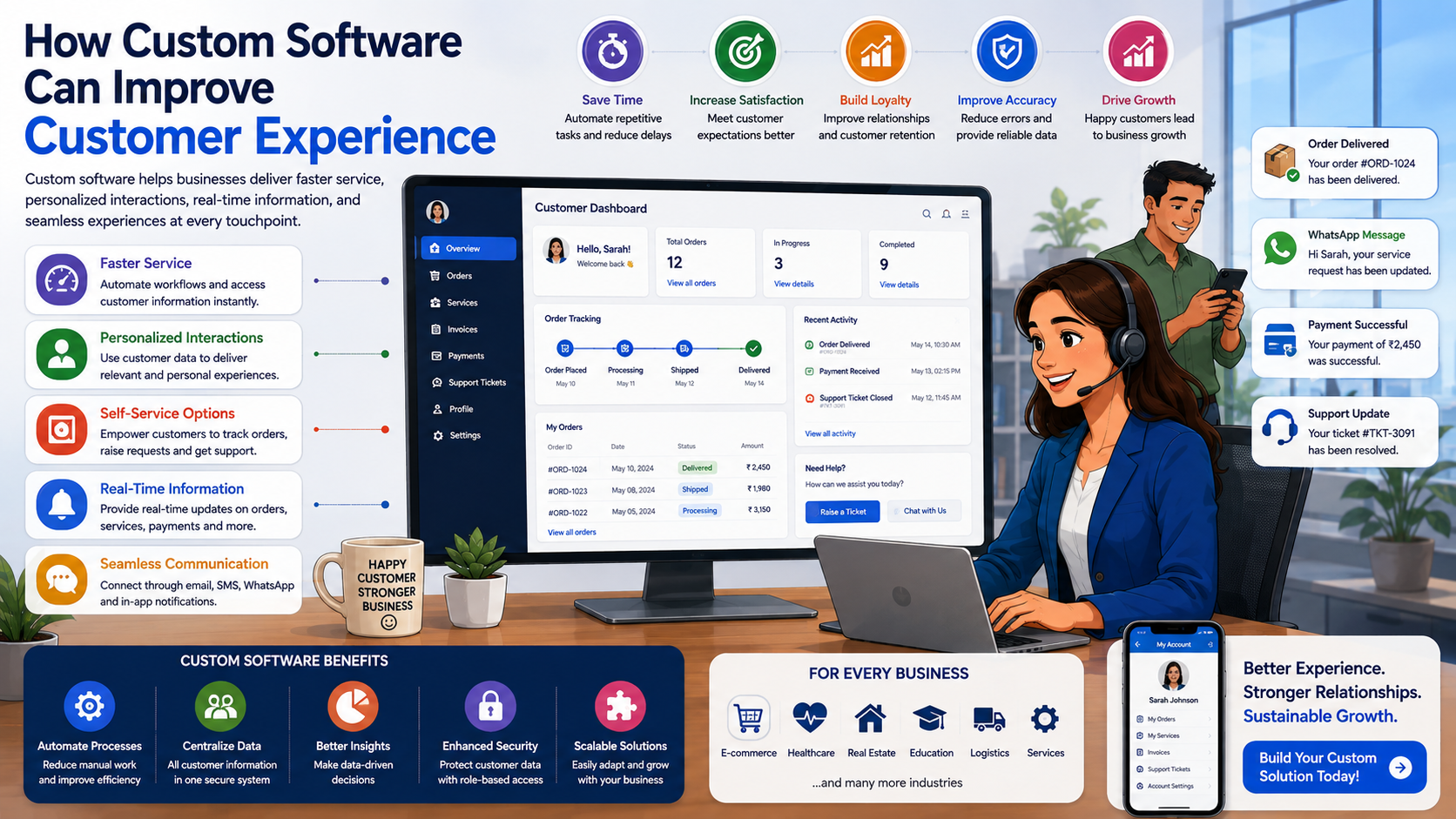
4. Improves Customer Experience
Customer expectations continue to increase. Businesses need to provide convenient and responsive services to remain competitive.
Custom software can support features such as:
· Customer portals
· Online booking
· Order tracking
· Personalized dashboards
· Automated notifications
· Customer support systems
· Online payments
A smoother customer experience can help businesses build stronger customer relationships and encourage repeat business.
5. Provides Faster Access to Business Information
Making decisions based on outdated or incomplete information can slow down a business.
Custom software can provide dashboards and reports that bring important business information together.
Managers can monitor areas such as:
· Sales
· Revenue
· Customer activity
· Inventory
· Expenses
· Employee performance
· Operational metrics
Having timely information can help businesses identify opportunities and respond more quickly to changing conditions.
6. Connects Different Business Systems
Businesses often use multiple software platforms for different functions.
Custom software can connect systems such as:
· CRM
· ERP
· Accounting software
· E-commerce platforms
· Payment gateways
· SMS
· Third-party APIs
Integrating these systems can reduce manual work and create a more connected business environment.
7. Helps Businesses Respond to Market Changes
Market conditions can change quickly. Businesses may need to introduce new services, modify workflows, launch new products, or change how they interact with customers.
Custom software provides greater flexibility to adapt the system as requirements change.
Instead of waiting for a software provider to introduce a feature, businesses can plan enhancements based on their own priorities.
This flexibility can be particularly valuable for growing organizations.
8. Supports Business Scalability
A solution that works for a small company may need to support significantly more users, customers, locations, and transactions as the business grows.
Custom software can be designed with scalability in mind.
Businesses can add:
· New users
· New departments
· New modules
· New locations
· New integrations
· Additional reports
· New workflows
This allows the software to evolve alongside the organization.
9. Helps Reduce Operational Costs
Custom software can help businesses reduce costs by improving efficiency and reducing unnecessary manual work.
Potential areas of savings include:
· Administrative tasks
· Manual data entry
· Duplicate processes
· Multiple disconnected software tools
· Operational errors
· Manual reporting
The actual cost savings depend on the business process and the software solution implemented.
10. Gives Businesses Better Control Over Their Processes
With generic software, businesses often need to work within predefined workflows.
Custom software provides greater control over how processes operate.
Businesses can define:
· User roles
· Approval processes
· Notifications
· Workflows
· Reports
· Permissions
· Business rules
This can make the software more closely aligned with the organization's operational strategy.
11. Creates Opportunities for Innovation
Custom software can provide a foundation for introducing new digital services and business models.
For example, businesses can develop:
· Customer portals
· Mobile applications
· Subscription platforms
· Online marketplaces
· Automated service systems
· Self-service platforms
· Industry-specific applications
Technology can therefore become more than an operational tool—it can become part of the company's competitive strategy.
12. Improves Data-Driven Decision Making
Businesses need reliable information to understand what is working and where improvements are required.
Custom dashboards can bring together data from different business functions and present it in an easy-to-understand format.
For example:
Sales Data → Customer Data → Operational Data → Analytics → Business Decisions
This can help management identify trends, monitor performance, and make more informed decisions.
Custom Software vs. Off-the-Shelf Software
| Custom Software | Off-the-Shelf Software |
| Designed around specific business requirements | Designed for a broad range of businesses |
| Flexible workflows | Predefined workflows |
| Custom features | Standard features |
| Can be integrated with required systems | Integration options vary |
| Can scale according to business needs | Scalability depends on the platform |
| Greater control over functionality | More limited customization |
| Higher initial development investment | Often quicker to deploy |
Off-the-shelf software can be an excellent choice when its existing functionality meets your business requirements. Custom software becomes more valuable when your processes are specialized or existing solutions create limitations.
Signs Your Business May Need Custom Software
Consider custom software development if:
· Your team relies heavily on spreadsheets
· Employees perform repetitive manual tasks
· You use multiple disconnected systems
· Existing software does not match your workflow
· Your business needs specialized functionality
· You require custom reports and dashboards
· Your processes are difficult to automate
· Your business is expanding rapidly
· You need multiple systems to communicate with each other
How to Build a Competitive Custom Software Solution
A successful custom software project should begin with a clear understanding of your business.
Step 1: Identify Business Challenges
Determine which processes are inefficient, repetitive, or difficult to manage.
Step 2: Define Business Requirements
Identify the features, users, workflows, integrations, and reports required.
Step 3: Design the User Experience
Create simple and intuitive interfaces that employees and customers can use easily.
Step 4: Develop the Software
Build the application according to the approved requirements and technical architecture.
Step 5: Integrate Required Systems
Connect the software with CRM, ERP, payment gateways, APIs, communication tools, or other platforms.
Step 6: Test the Application
Test functionality, security, performance, integrations, and user workflows.
Step 7: Launch and Improve
Deploy the software and continue improving it based on business requirements and user feedback.
At Mugin Technologies, we develop custom software solutions designed around specific business requirements.
Our services include:
· Custom Software Development
· Custom Web Application Development
· Business Automation Solutions
· CRM Development
· ERP Development
· SaaS Application Development
· API Integration
· Dashboard and Reporting Solutions
· Cloud-Based Software Development
· Software Maintenance and Support
We focus on building secure, scalable, user-friendly, and business-focused solutions that can adapt as your organization grows.
Custom software can give businesses a competitive advantage by helping them work more efficiently, automate repetitive processes, improve customer experiences, integrate systems, and make better use of business data.
The biggest advantage is flexibility. Instead of forcing your business to follow a predefined software workflow, a custom solution can be designed around the way your organization actually operates.
For businesses with specialized requirements, growing operations, or complex workflows, custom software can become a valuable long-term technology investment that supports efficiency, innovation, and sustainable growth.